Keratin Bond Extensions for Fine Hair: When They Work and When They Don't
Candidate selection, section size, density, tension, maintenance, when keratin bonds are not appropriate, and when toppers or integration are better.
Keratin bond extensions can work for fine hair when the client has enough healthy density to support individual bonds, the sections are properly sized, the placement is clean, and the client can maintain them. They may not be appropriate for fragile hair, active shedding, scalp concerns, or clients who need crown or part-line coverage instead of length or fullness.
That is the honest answer.
Keratin bonds can be beautiful on the right fine-hair client. They can create natural movement, detailed placement, and subtle fullness without relying on a full row of hair.
But they are not safe or appropriate for every fine-hair client.
Fine hair does not automatically mean weak hair. Thin hair does not automatically mean fine hair. And a client with hair loss may need coverage, not extensions.
This guide explains when keratin bonds may work for fine hair, when they may not, what stylists should evaluate before installation, and when Zora Wisp Weft, hair toppers, meshless integration, mesh integration, or wigs may be better.
Fine Hair vs. Thin Hair: The Difference Matters
Before recommending keratin bonds, stylists need to separate fine hair from thin hair.
Fine hair means each individual strand has a smaller diameter.
Thin hair means the client has reduced density, visible scalp, a widening part line, crown thinning, or fewer strands than before.
A client can have fine hair with strong density. That client may be a good keratin bond candidate.
Another client can have medium-textured hair but low density and scalp visibility. That client may not be a good keratin bond candidate.
This distinction matters because keratin bonds need enough natural hair to support the added hair.
Harvard Health reports that about one-third of women experience hair loss at some point in their lives, and that female pattern hair loss often appears as thinning at the part line followed by diffuse hair loss from the top of the head.
A stylist's job is not to diagnose the cause of hair loss. A stylist's job is to evaluate whether the client is a safe candidate for a cosmetic hair enhancement service and refer to a medical provider when symptoms suggest the client needs medical evaluation.
When Keratin Bonds Can Work for Fine Hair
Keratin bonds may work well for fine hair when the client has enough healthy density to support small, individual attachment points.
They may be appropriate when the client has:
- Fine hair texture but enough density
- Minimal scalp visibility
- Healthy anchor hair
- A desire for natural movement
- A need for detailed placement
- Thin ends or sparse mids that need fullness
- A lifestyle that supports maintenance
- Realistic expectations
- A stylist trained in keratin bond placement and removal
The strength of keratin bonds is control. Because they are placed in small sections, the stylist can add fullness more selectively than with a row-based method. This can be helpful when the client does not need a full weft row or when the stylist wants more movement through specific areas.
For the right fine-hair client, keratin bonds can look very natural. But "fine hair" alone is not enough to approve the method. The client must have enough support hair.
When Keratin Bonds May Not Be Right for Fine Hair
Keratin bonds may not be appropriate when the client's hair cannot safely support the attachment points.
They may be a poor fit when the client has:
- Active shedding
- Very fragile hair
- Breakage near the attachment area
- Significant scalp visibility
- Widening part line
- Crown thinning
- Too little density to hide the bonds
- Scalp irritation, sores, inflammation, or pain
- Poor maintenance habits
- A need for coverage more than length or fullness
This is where stylists have to be honest. If the client's hair is too sparse or fragile, adding individual bonds may create stress instead of a solution.
If the client's biggest concern is the top of the head, keratin bonds may not solve the actual problem. A client who needs crown or part-line coverage may be better suited for a hair topper, beaded topper method, meshless integration, mesh integration, or a wig consultation.
Do not force keratin bonds onto a client who needs coverage.
The Most Important Question: Is There Enough Support Hair?
Keratin bonds rely on the client's natural hair for support. That means the natural section must be strong enough to hold the bond without creating too much stress.
Before installing keratin bonds, stylists should evaluate:
| Question | Why It Matters |
|---|---|
| Is there enough density to hide the bonds? | Prevents visible attachment points |
| Is the hair strong enough to support added weight? | Reduces stress on natural hair |
| Is the client actively shedding? | May indicate the service should wait |
| Is the scalp healthy? | Helps identify referral concerns |
| Can the client maintain the bonds? | Protects longevity and comfort |
| Does the client need fullness or coverage? | Determines whether bonds solve the real issue |
| Is the section size appropriate? | Prevents overload on fine hair |
| Is the client realistic about care? | Reduces maintenance problems |
If the answer to these questions is unclear, slow down. A rushed consultation creates a risky service.
Section Size Matters More on Fine Hair
Fine hair requires careful sectioning. If the section is too small, the bond may place too much stress on too little natural hair. If the section is too large, the bond may not move naturally or may create an uneven result.
Stylists should think about:
- Natural density
- Strand strength
- Section size
- Bond size
- Weight distribution
- Placement pattern
- Client styling habits
- Maintenance commitment
- Removal plan
Keratin bonds are not just "tiny extensions." They are individual attachment points that need to be balanced with the client's natural hair. The finer the hair, the more precise the placement needs to be.
Keratin Bonds vs. Zora Wisp Weft for Fine Hair
Keratin bonds and flat wefts solve different problems.
Keratin bonds may be better when the stylist needs detailed strand-by-strand placement.
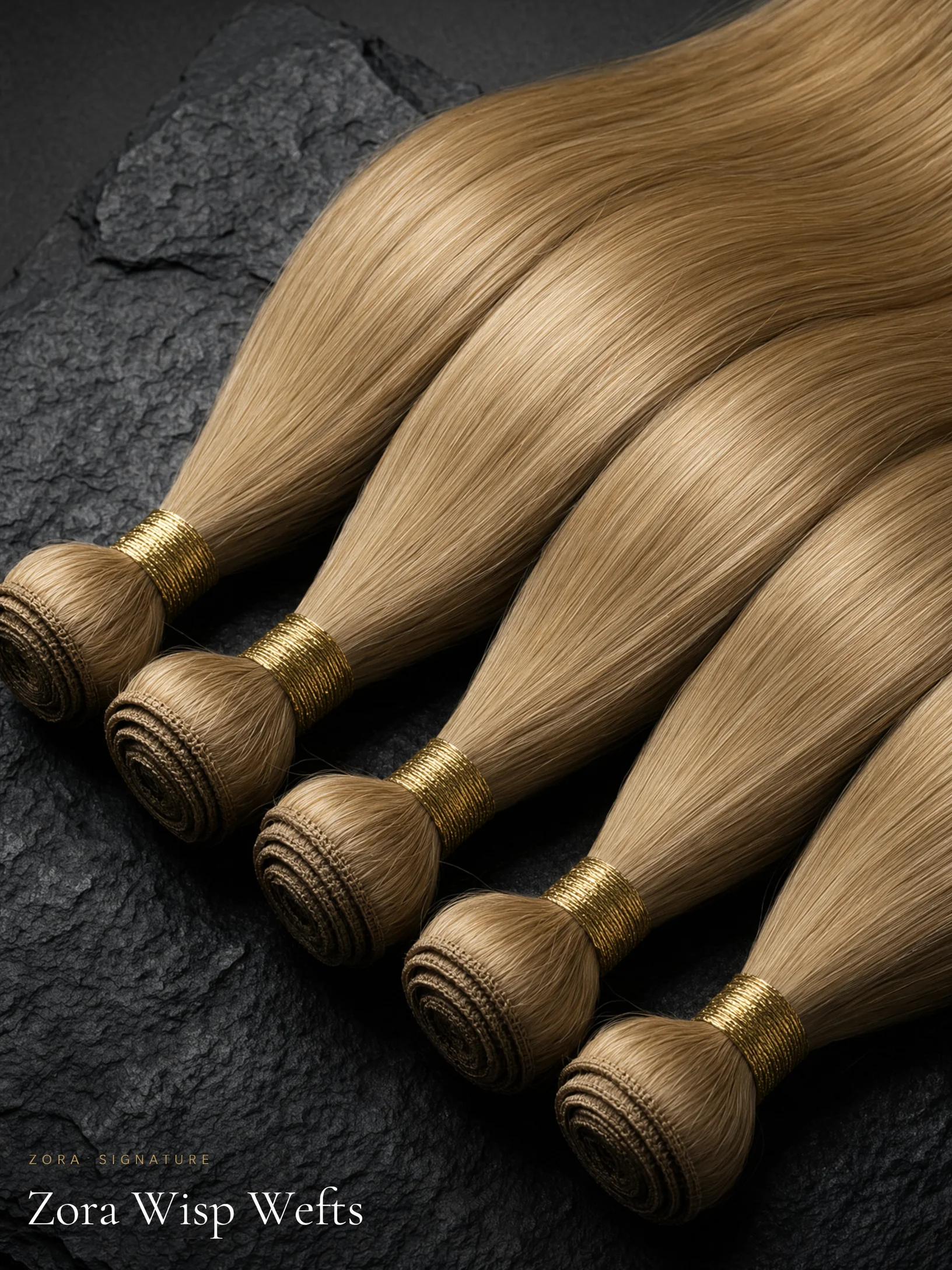
Zora Wisp Weft is Zora Hair's flat weft for licensed cosmetologists. It may be better when the client has enough anchor hair and wants low-bulk fullness through a row-based install.
| Client Need | Better Starting Point |
|---|---|
| Detailed placement around specific areas | Keratin bonds |
| Low-bulk fullness through a row | Zora Wisp Weft |
| Fine hair with enough density but no crown concern | Keratin bonds or Wisp Weft |
| Smaller areas needing targeted fullness | Keratin bonds |
| Fuller mids and ends with enough anchor hair | Zora Wisp Weft |
| Crown thinning or part-line visibility | Hair topper or integration |
| Advanced hair loss | Meshless integration, mesh integration, or wig |
Many stylists search for Genius Weft when they want a low-bulk weft option. That does not mean every fine-hair client needs a weft. Some need bonds. Some need Wisp Weft. Some need toppers. Some need integration. The method should follow the client's hair.
Keratin Bonds vs. Hair Toppers for Fine or Thinning Hair
This is an important distinction.
Keratin bonds add fullness or length where the client has enough natural hair to support the bonds.
Hair toppers add coverage where the client is missing density on the top, crown, or part line.
| Client Concern | Better Direction |
|---|---|
| Thin ends | Keratin bonds or Wisp Weft |
| Sparse mids | Keratin bonds |
| Crown thinning | Hair topper |
| Widening part line | Hair topper |
| Visible scalp on top | Topper or integration |
| Needs detailed fullness but has enough density | Keratin bonds |
| Needs coverage more than length | Hair topper or integration |
A client may ask for keratin bonds because she wants "more hair." But if she is really worried about her part line or crown, bonds may not solve that concern. A topper may be the more honest recommendation.
Keratin Bonds for Hair Loss Clients: Be Careful
Some hair loss clients may be candidates for keratin bonds. Many are not.
Keratin bonds may be considered when the client has:
- Enough healthy density
- No active shedding
- Strong enough support hair
- A need for targeted fullness
- Minimal scalp visibility in the placement area
- A willingness to maintain the bonds properly
Keratin bonds may not be appropriate when the client has:
- Active shedding
- Sudden unexplained hair loss
- Visible scalp through the top
- Crown thinning
- Part-line thinning
- Too little support hair
- Scalp pain, irritation, inflammation, scaling, or sores
The American Academy of Dermatology warns that repeated pulling from tight hairstyles, extensions, or weaves can contribute to traction alopecia over time, which is why stylists must respect tension, support hair, and client selection.
If a client has sudden shedding, patchy loss, scalp pain, inflammation, scaling, sores, or rapidly progressing thinning, she should be encouraged to see a dermatologist or qualified medical provider before any attachment-based service.
Maintenance Is Not Optional
Keratin bonds require maintenance discipline. A client who will not brush properly, separate bonds, avoid habits that create matting, or return for maintenance may not be a good candidate.
Keratin bond clients need to understand:
- How to brush safely
- How to wash and dry properly
- What products to avoid
- How to avoid tangling near the bonds
- Why bond separation matters
- When maintenance or removal is needed
- What discomfort signs should be reported
- Why rough handling can create problems
A good keratin bond install can fail if the client does not maintain it. That conversation needs to happen before installation, not after the client has a problem.
Placement Planning for Fine Hair
Fine-hair clients often need more thoughtful placement. Stylists should evaluate:
- Hairline strength
- Parting habits
- Ponytail habits
- Density at the sides
- Density at the nape
- Crown visibility
- Desired fullness
- Desired length
- Natural movement
- Client styling habits
Keratin bonds may not be ideal in every zone. Some areas may have enough support hair. Others may not. A stylist may choose a partial placement, a combination method, or a completely different solution. The goal is not to place as many bonds as possible. The goal is to place the right amount of hair in the right areas.
Common Mistakes with Keratin Bonds on Fine Hair
Mistake 1: Confusing fine hair with low-density hair
Fine hair may still have enough density. Low-density hair may not.
Mistake 2: Using sections that are too small
Too much added hair on too little natural hair can create stress.
Mistake 3: Ignoring active shedding
If the client is actively shedding, the service may need to wait.
Mistake 4: Trying to cover the crown with bonds
Keratin bonds add fullness. They do not replace a topper when the client needs top coverage.
Mistake 5: Skipping maintenance education
Keratin bond clients need clear care instructions.
Mistake 6: Promising a fixed wear time
Longevity depends on hair growth, maintenance, lifestyle, product, and stylist recommendation.
Mistake 7: Poor removal
Improper removal can create unnecessary stress. Removal should be done by a trained professional.
When Zora Keratin Bonds May Be the Better Direction
Zora Keratin Bonds may be a strong direction when the stylist needs detailed strand-by-strand fullness for a client with enough healthy density.
They may fit when:
- The client wants subtle fullness
- The stylist needs targeted placement
- The client has enough support hair
- The goal is natural movement
- A row-based method is not ideal
- The client can follow maintenance instructions
They may not fit when:
- The client has too little density
- The client needs crown coverage
- The client has active shedding
- The client's hair is too fragile
- The scalp needs medical evaluation
- The client cannot maintain the method
Keratin bonds are a precision tool. They should be used with precision.
When Zora Wisp Weft May Be the Better Direction
Zora Wisp Weft is Zora Hair's flat weft for licensed cosmetologists.
It may be a better direction when the client has enough anchor hair and needs low-bulk fullness or length through a row-based install.
Wisp Weft may fit when:
- The client has enough anchor hair
- The client wants fuller mids or ends
- The stylist wants low-bulk row-based fullness
- The client does not need top coverage
- The client can maintain a row-based method
Wisp Weft may not fit when:
- The client needs crown coverage
- The client has visible part-line thinning
- The client has too little support hair
- The client needs a topper, meshless integration, mesh integration, or wig
This is not a competition between products. It is method selection.
"Keratin bonds can be beautiful on fine hair, but only when the client has enough density to support them. I look at section size, strand strength, shedding, and whether the client really needs fullness or coverage. If she needs coverage at the crown or part line, I'm not forcing bonds — I'm thinking topper or integration."
— Krista Abad, Zora Hair Ambassador and 25-year hair extension and hair loss integration specialist
Common Questions About Keratin Bonds for Fine Hair
Keratin bond extensions can be good for some fine-hair clients when there is enough healthy density to support the bonds. They may not be appropriate for fragile hair, active shedding, scalp concerns, or clients who need crown or part-line coverage.
Any attachment-based method can create problems if the client is not a good candidate, if the sections are too small, if the bonds are too heavy, if maintenance is poor, or if removal is done incorrectly. Proper consultation, placement, maintenance, and removal are essential.
Not automatically. Keratin bonds may be better for detailed strand-by-strand placement. Zora Wisp Weft may be better when the client has enough anchor hair and wants low-bulk row-based fullness. The right choice depends on the client.
They may help some clients who have mild thinning and enough support hair, but they are not the right fit for every thinning-hair client. If the client needs top coverage, a topper or integration method may be better.
The number depends on the client's density, desired result, head shape, hair length, and stylist recommendation. Stylists should avoid giving a fixed number without evaluating the client.
Longevity depends on the product, application, natural hair growth, maintenance, lifestyle, and removal timing. Stylists should avoid promising fixed wear times without evaluating the client.
A topper is usually the better starting point when the client needs crown or part-line coverage. Keratin bonds are generally better for adding length or fullness where the client has enough support hair.
If the client has sudden shedding, unexplained hair loss, scalp pain, inflammation, scaling, sores, patchy loss, or rapidly progressing thinning, she should be encouraged to see a dermatologist or qualified medical provider before attachment-based services.
Summary
Keratin bond extensions can work beautifully for fine hair when the client has enough healthy density, the sections are properly sized, the placement is clean, and the client can maintain them.
They may not be appropriate when the client has active shedding, fragile hair, scalp symptoms, too little support hair, crown thinning, or a need for coverage instead of fullness.
Zora Keratin Bonds may be a strong option when the stylist needs detailed strand-by-strand placement.
Zora Wisp Weft is Zora Hair's flat weft for licensed cosmetologists and may be the better option when the client has enough anchor hair and wants low-bulk row-based fullness.
The best stylists do not force keratin bonds onto every fine-hair client. They evaluate the hair first, then choose the method.
Need professional extension options for fine-hair clients?
Explore Zora Keratin Bonds, Zora Wisp Weft, and Zora's professional hair enhancement products for licensed cosmetologists.
Keywords
Professional Access
Questions about Zora Hair?
Contact hello@zorahair.com for current product information. Program details and purchasing terms will be announced.
Professional Inquiries