Best Hair Extension Methods for Fine or Thinning Hair Clients
The master decision guide connecting Wisp Weft, keratin bonds, toppers, beaded toppers, meshless integration, mesh integration, and when not to use extensions.
The best hair extension method for fine or thinning hair depends on one question: does the client have enough healthy anchor hair to safely support extensions? If yes, low-bulk wefts, keratin bonds, or hand-tied row-style installs may work. If not, hair toppers, beaded topper method, meshless integration, mesh integration, or wigs may be better.
That is the honest answer.
Fine hair and thinning hair are not the same thing. A client can have fine hair texture but still have enough density for extensions. Another client can have medium hair texture but visible thinning at the crown, part line, or temples.
Those two clients need different recommendations.
This guide helps licensed stylists choose between Zora Wisp Weft, keratin bonds, hair toppers, beaded topper method, meshless integration, mesh integration, and future wig options for clients with fine, thin, or hair-loss-affected hair.
Fine Hair vs. Thinning Hair: Why the Difference Matters
Before choosing an extension method, stylists need to separate hair texture from hair density.
Fine hair means the individual strand is small in diameter. A client with fine hair may still have a lot of hair on her head.
Thinning hair means the client has reduced density, visible scalp, widening part line, crown thinning, shedding, or reduced coverage compared with her previous baseline.
That distinction matters because extension success depends less on the strand texture alone and more on whether the client has enough healthy hair to support the method.
A fine-hair client may be a great candidate for extensions if she has enough density. A thinning-hair client may need a topper or integration method instead of traditional extensions if she does not have enough anchor hair.
Harvard Health reports that about one-third of women experience hair loss at some point in their lives, and among postmenopausal women, as many as two-thirds experience thinning or bald spots. The American Academy of Dermatology also notes that many new mothers experience noticeable postpartum shedding a few months after having a baby, and that most women regain normal fullness by their child’s first birthday.
For stylists, this means the consultation cannot be lazy. You are not just adding hair. You are choosing the correct hair enhancement based on density, scalp visibility, lifestyle, and long-term safety.
The First Question: Does the Client Have Enough Anchor Hair?
Before recommending any weft, bond, or row-based method, ask: Does this client have enough healthy anchor hair to support the installation without creating too much stress?
Anchor hair is the natural hair that supports the added hair.
If the anchor hair is too weak, sparse, fragile, or compromised, the wrong extension method can make the client’s situation worse.
That is especially important because the American Academy of Dermatology warns that hairstyles or methods that repeatedly pull on the hair can contribute to traction alopecia, and tight hairstyles, extensions, or weaves can be a factor when they place too much stress on the hair.
This does not mean extensions are bad. It means the method has to match the client.
A strong stylist asks:
- Where is the density strongest?
- Where is the density weakest?
- Is the scalp visible?
- Can the client support a row?
- Is the part line thinning?
- Is the crown thinning?
- Is there breakage or active shedding?
- Is the client under medical care for hair loss?
- Does the client need fullness, coverage, or both?
The answer determines the method.
Quick Decision Guide: Which Method Fits Which Client?
Use this as a starting point, not a replacement for a professional consultation.
| Client Situation | Better Starting Point | Why |
|---|---|---|
| Fine hair with enough density | Zora Wisp Weft or keratin bonds | Adds fullness without using bulky traditional wefts |
| Medium-density hair needing low-bulk rows | Zora Wisp Weft | Supports customizable row-based installs |
| Fine hair needing small, detailed placement | Keratin bonds | Allows strand-by-strand control |
| Crown thinning or widening part line | Hair topper | Adds coverage where extensions cannot |
| Diffuse thinning with enough support for integration | Meshless integration or mesh integration | Creates a more complete hair enhancement solution |
| Client needs removable or semi-permanent top coverage | Beaded topper method | Gives coverage and professional placement |
| Advanced hair loss or full coverage need | Wig, when appropriate | Provides broader coverage when extensions are not enough |
The mistake is treating every client as an extension client. Some clients need length. Some need density. Some need coverage. Some need all three.
That is why Zora’s hair enhancement approach includes wefts, keratin bonds, toppers, integration methods, and future wigs.
Method 1: Zora Wisp Weft for Low-Bulk Row-Based Installs
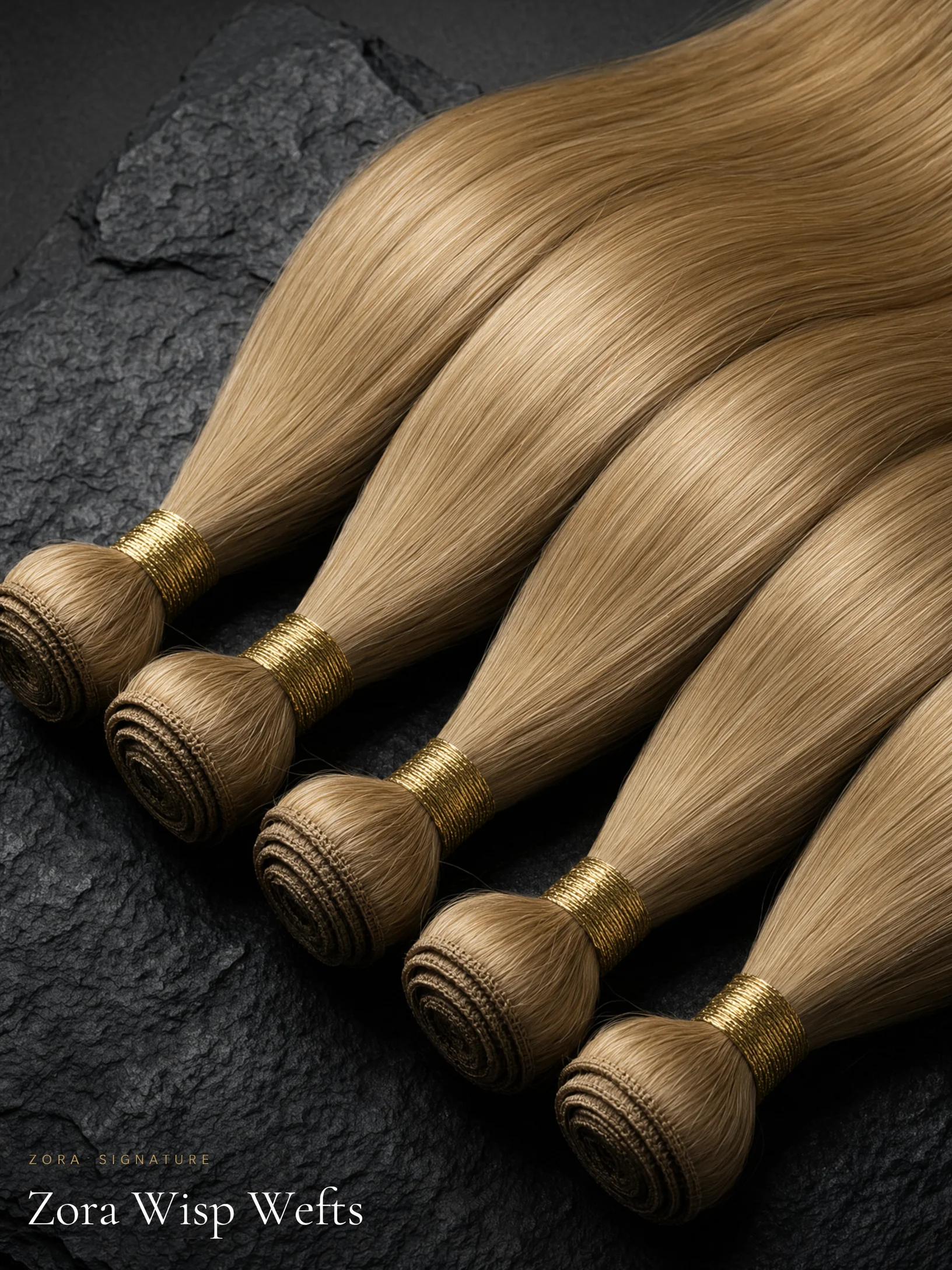
Zora Wisp Weft is Zora Hair’s flat weft for licensed cosmetologists.
It is designed for stylists who want a professional low-bulk weft option for row-based installs where discretion, customization, and client fit matter.
Stylists often search for Genius Weft when they are looking for this kind of low-bulk, customizable weft option. The goal is usually to create a flatter, less bulky row than a traditional machine weft.
Zora Wisp Weft may be a good choice when the client has:
- Fine hair with enough density to support a row
- Medium-density hair where lower bulk is preferred
- Enough anchor hair through the installation area
- A need for width customization
- A desire for fullness or length without a bulky track
- A lifestyle that supports regular maintenance
Zora Wisp Weft may not be the best choice when the client has:
- Advanced crown thinning
- Significant scalp visibility
- Too little anchor hair
- Active shedding or scalp irritation
- A need for coverage at the part line or crown
- A better fit for a topper or integration method
This is the key: Wisp Weft is not for every hair loss client. It is for the right client — the one with enough support for a low-bulk row-based install.
Method 2: Keratin Bonds for Detailed Strand-by-Strand Placement
Keratin bonds can be a strong option for fine hair when the client has enough healthy density and the stylist needs more detailed placement than a row-based method allows.
Unlike a weft, keratin bonds are applied in small sections. That gives the stylist more control over where fullness is added.
Keratin bonds may be useful when:
- The client needs targeted fullness
- The stylist wants strand-by-strand placement
- The client has enough density to support the bonds
- The goal is natural movement
- Row-based installs are not ideal for the client’s head shape or density pattern
Keratin bonds may not be the best option when:
- The client has very fragile hair
- There is active shedding
- There is insufficient density
- The client cannot commit to proper maintenance
- The client needs top or crown coverage instead of length or fullness
Keratin bonds can be beautiful, but they require discipline from both stylist and client. The sections have to be appropriate. The placement has to be clean. Maintenance has to be respected.
If the client is not a good candidate, the method should not be forced.
Method 3: Hand-Tied Wefts for Soft, Lightweight Movement
Hand-tied wefts can be a strong option for fine-hair clients who have enough density and want soft movement with a lightweight feel.
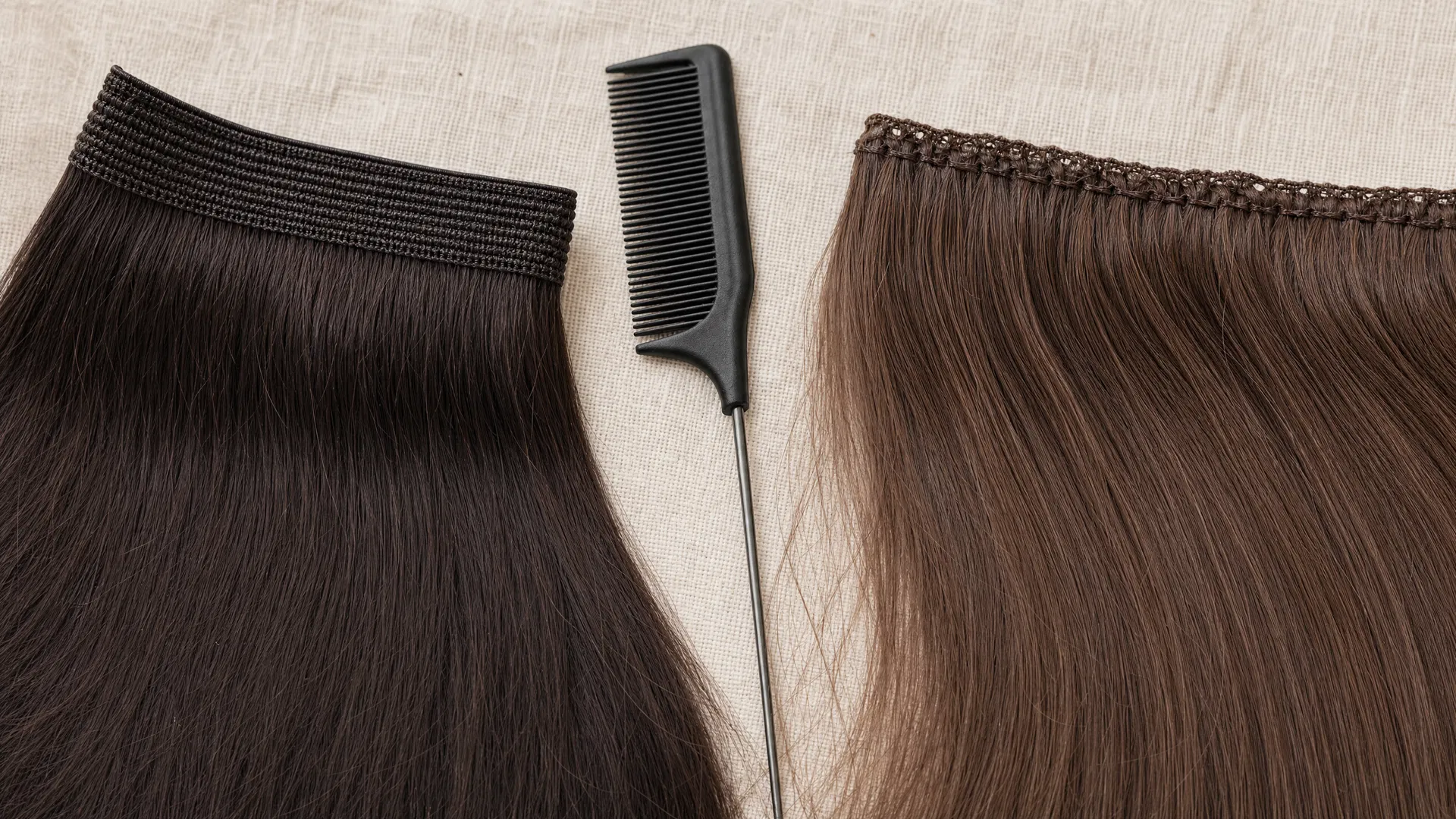
A hand-tied weft is constructed differently from a flat weft or Genius Weft-style product. It is usually soft, flexible, and lightweight, but it is generally not designed to be cut through the weft itself.
Hand-tied wefts may be a good choice when:
- The client has enough anchor hair
- Soft movement is the priority
- The stylist does not need major width customization
- The client can maintain the install properly
- The stylist is trained in the method
Hand-tied wefts may not be ideal when:
- The stylist needs to customize the width
- The client has a head shape requiring more cut control
- The client has insufficient density
- The client needs crown or part-line coverage
- The stylist needs a more customizable low-bulk weft
Hand-tied wefts are not “better” or “worse” than flat wefts. They solve a different problem. A serious stylist knows when each one belongs.
Method 4: Hair Toppers for Crown and Part-Line Coverage
When the client has thinning at the crown, part line, or top of the head, extensions may not solve the real problem. That is where a hair topper can become the better recommendation.
A topper is designed to add coverage where density is missing. Extensions add length and fullness where there is enough natural hair to support the added hair. Those are different jobs.
Hair toppers may be a good option when the client has:
- Crown thinning
- Widening part line
- Visible scalp on top
- Diffuse thinning through the top section
- Enough perimeter hair for blending
- A need for coverage more than length
A topper may not be the right fit when:
- The client only wants length
- The client has enough density for extensions and does not need top coverage
- The topper base, density, or attachment method does not match the client’s lifestyle
- The client needs a more advanced integration method
A topper can be life-changing for the right client. But it has to be chosen correctly. Base size, density, color, parting, attachment method, and blend all matter.
Method 5: Beaded Topper Method for Professional Topper Placement
The beaded topper method can help stylists serve clients who need top coverage but want a professional, more secure option than clipping a topper in and out daily.
This method is especially relevant for stylists who serve hair loss clients and want to expand beyond traditional extensions.
Beaded topper method may be appropriate when:
- The client needs crown or part-line coverage
- The client has enough hair to support the attachment points
- The client wants a more secure topper experience
- The stylist is trained in the method
- The client understands maintenance requirements
It may not be appropriate when:
- The client has too little support hair
- The scalp is irritated or medically compromised
- The client needs a different integration method
- The client cannot commit to maintenance
- The attachment would create too much stress
This is not a method to guess through. It requires training, consultation, and professional judgment.
Method 6: Meshless Integration for Diffuse Thinning
Meshless integration is part of the professional hair loss integration world. It can be used when a client needs more support than traditional extensions but may not require full mesh integration.
This method is not just about adding hair. It is about creating a customized enhancement plan for clients with thinning or density challenges.
Meshless integration may be appropriate when:
- The client has diffuse thinning
- The client needs coverage and density support
- The client is not well served by standard extensions alone
- The stylist is trained in the method
- The client understands maintenance and follow-up
It may not be appropriate when:
- The client needs full coverage
- The client has active scalp issues
- The client’s density cannot support the method
- The stylist has not been trained
- A topper, wig, or different solution is safer
Meshless integration should never be positioned as a casual add-on. It is a specialized service.
Method 7: Mesh Integration for More Advanced Coverage Needs
Mesh integration can be used for clients who need a more complete support structure for hair loss integration.
This can be useful when traditional extensions are not enough and the client needs a more advanced enhancement system.
Mesh integration may be appropriate when:
- The client has more advanced diffuse thinning
- The client needs more structured support
- The goal is both coverage and density
- The stylist has proper training
- The client is ready for maintenance
It may not be appropriate when:
- The client needs a simpler solution
- The client cannot commit to maintenance
- The scalp needs medical evaluation first
- The stylist is not trained in the method
- A wig or topper is a better fit
Mesh integration is not just a product choice. It is a professional service category. That is why Zora teaches hair loss integration through the Hair Loss Integration Masterclass, including beaded topper method, meshless integration, and mesh integration.
Method 8: Wigs for Full Coverage Needs
Zora’s wig line is coming in the future, but wigs should already be part of the consultation conversation.
Why? Because some clients are not extension clients.
A wig may be the better direction when the client has:
- Advanced hair loss
- Extensive scalp visibility
- Too little anchor hair
- A need for full coverage
- Medical hair loss
- A preference for removable coverage
- A lifestyle that does not support bonded or row-based methods
A wig should not be treated as a last resort. For the right client, it can be the most comfortable, realistic, and protective solution.
Until Zora’s wig line launches, wigs are a future category — not a product currently available.
Extension Method Comparison for Fine or Thinning Hair
Here is a practical comparison for stylists.
| Method | Best For | Be Careful When |
|---|---|---|
| Zora Wisp Weft | Low-bulk row-based fullness with enough anchor hair | Crown thinning or insufficient density |
| Keratin bonds | Detailed strand-by-strand placement | Fragile hair or poor maintenance habits |
| Hand-tied wefts | Lightweight movement and soft layering | Width customization is needed |
| Hair toppers | Crown and part-line coverage | Client only needs length, not coverage |
| Beaded topper method | More secure professional topper placement | Client lacks support hair or cannot maintain it |
| Meshless integration | Diffuse thinning needing enhanced support | Client needs full coverage or has scalp concerns |
| Mesh integration | More advanced density and coverage support | Stylist lacks training or client cannot maintain it |
| Wigs | Full coverage or advanced hair loss | Client needs partial enhancement only |
This table should not replace a consultation. It should guide one.
The Biggest Mistake: Recommending Extensions When the Client Needs Coverage
This is the mistake that hurts trust.
A client comes in asking for extensions because she wants more hair. But what she really needs is coverage.
If the client has thinning at the top, crown, or part line, adding wefts or bonds may not solve the visible problem. In some cases, it can draw more attention to the areas that are thinning.
Extensions are best when the client has enough hair to support the added hair. Toppers and integration methods are better when the client needs coverage.
That is the difference.
A stylist who understands this becomes more than an extension installer. She becomes a hair enhancement specialist.
Expert Note from Krista
“The first thing I look at is whether the client needs length, density, coverage, or all three. If she has enough anchor hair, a weft or keratin bond method may be beautiful. But if the concern is crown thinning or scalp visibility, I’m thinking about toppers or integration first. The method has to match the problem.”
— Krista Abad, Zora Hair Ambassador and 25-year hair extension and hair loss integration specialist
Common Questions About Extensions for Fine or Thinning Hair
The best method depends on density, scalp visibility, and the client’s goals. If the client has enough anchor hair, Zora Wisp Weft, keratin bonds, or hand-tied row-style methods may work. If the client needs crown or part-line coverage, a topper or integration method may be better.
They can be, when the client has enough healthy anchor hair to support a row-based install. Many stylists search for Genius Weft when they want a low-bulk weft option. Zora Wisp Weft is Zora Hair’s flat weft for licensed cosmetologists.
Keratin bonds can work well for some fine-hair clients because they allow detailed strand-by-strand placement. They may not be appropriate for fragile hair, active shedding, or clients who cannot maintain the bonds properly.
Hair toppers are often better when the client needs coverage at the crown, part line, or top of the head. Extensions are usually better for adding length or fullness where there is enough natural hair to support the added hair.
Stylists should avoid forcing a method when the client lacks enough anchor hair, has active shedding, visible scalp exposure, or needs medical evaluation. The wrong method can create tension, discomfort, or a poor visual result.
Hair loss integration may be appropriate when the client needs more support than traditional extensions or toppers alone can provide. Methods may include beaded topper, meshless integration, or mesh integration depending on the client’s density, coverage needs, and maintenance commitment.
If a client has sudden shedding, unexplained hair loss, scalp irritation, pain, inflammation, or progressive thinning, she should be encouraged to see a dermatologist or qualified medical provider. Stylists can support cosmetic solutions, but they should not diagnose medical hair loss.
Summary
The best hair extension method for fine or thinning hair depends on the client’s density, anchor hair, scalp visibility, lifestyle, and goals.
If the client has enough healthy anchor hair, Zora Wisp Weft, keratin bonds, or hand-tied row-style methods may be appropriate. If the client needs crown coverage, part-line coverage, or support for more advanced thinning, hair toppers, beaded topper method, meshless integration, mesh integration, or wigs may be better.
Zora Wisp Weft is Zora Hair’s flat weft for licensed cosmetologists. It is one option inside a larger hair enhancement strategy.
The best stylists do not ask, “Which method is trending?” They ask, “What does this client actually need?”
Ready to choose better methods for fine, thin, and hair-loss clients?
Explore Zora’s professional hair enhancement options, including Zora Wisp Weft, keratin bonds, hair toppers, and the Hair Loss Integration Masterclass.
Apply for Professional Access Learn About the Hair Loss Integration Masterclass
Keywords
Professional Access
Questions about Zora Hair?
Contact hello@zorahair.com for current product information. Program details and purchasing terms will be announced.
Professional Inquiries