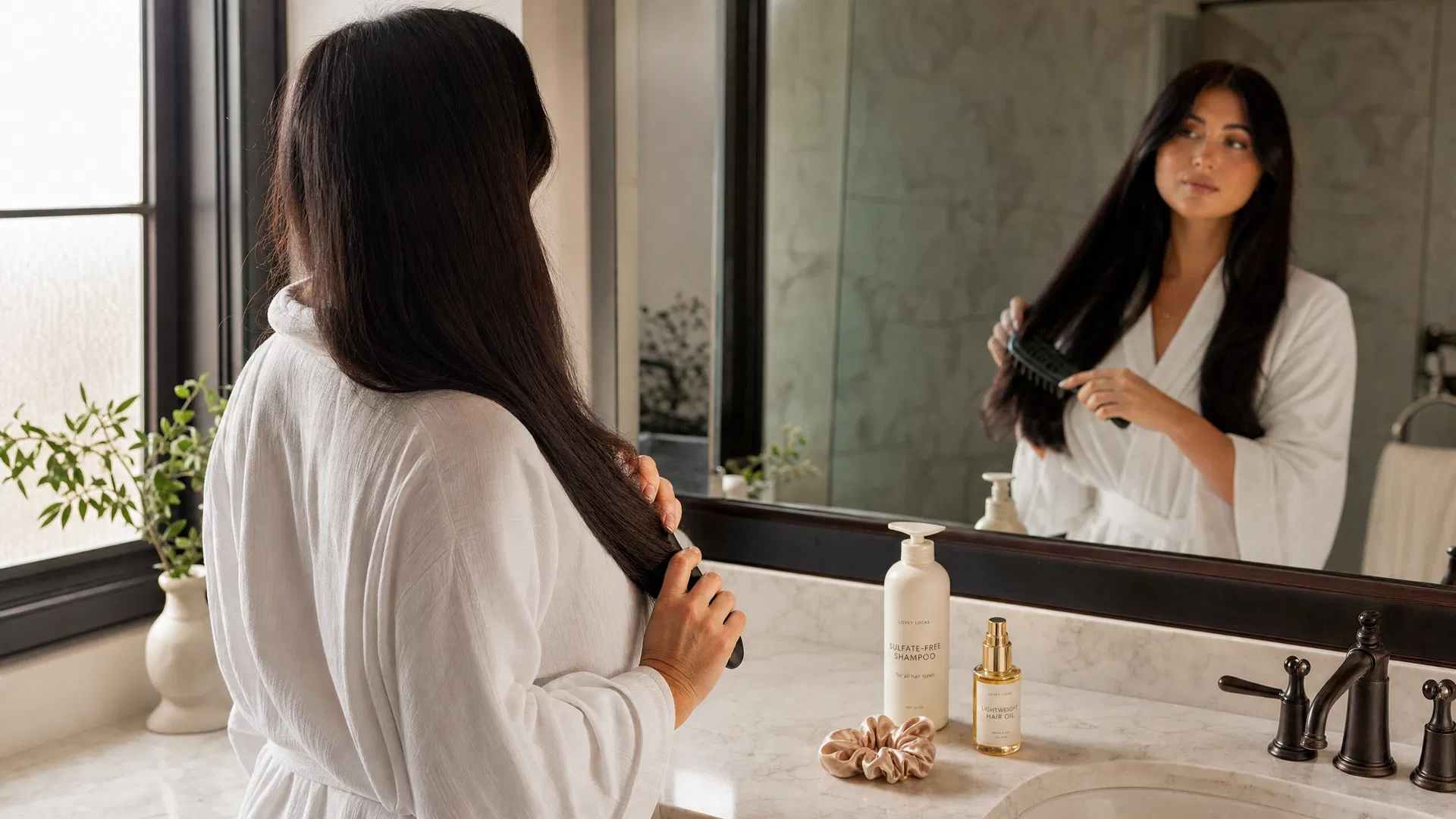
How to Care for Hair Extensions at Home: The Complete Stylist-Approved Guide
The right home care routine is the single biggest factor in how long your extensions last. This stylist-approved guide covers washing, brushing, drying, and sleeping with weft extensions and keratin bonds — with specific product guidance and the mistakes that shorten extension life.
Your extension stylist does the installation. Everything that happens between appointments is up to you. The home care routine you follow — or don’t follow — is the single biggest variable in how long your extensions last, how good they look at week ten versus week two, and whether your natural hair stays healthy throughout the process. This guide covers exactly what to do, what to avoid, and why each step matters for both weft extensions and keratin bond extensions.
The principles are the same for both methods, but there are a few technique differences worth noting. Where the guidance differs between wefts and keratin bonds, this guide will call it out specifically.
The Foundation: Why Extension Home Care Is Different
Natural hair is self-moisturizing. The scalp produces sebum, which travels down the hair shaft and keeps the hair conditioned from root to end. Extension hair does not have this mechanism. Once the hair is processed, packaged, and installed, it relies entirely on the products you apply and the care you give it to maintain its moisture balance. This is the fundamental reason extension home care requires more intentionality than caring for natural hair alone.
The attachment points — whether beads for weft extensions or keratin bonds for fusion extensions — add a second layer of complexity. Certain products, application methods, and habits that are harmless on natural hair can degrade the attachment over time, causing slippage, matting at the root, or premature shedding of extension strands. Understanding which habits to avoid is as important as understanding which habits to build.
Washing: The Most Important Step to Get Right
Shampoo Selection
The single most important product decision you will make for your extensions is your shampoo. Use a sulfate-free, paraben-free shampoo exclusively. Sulfates are surfactants — detergents that create lather and strip oil from the hair. They are effective on natural hair because the scalp replenishes the oil quickly. On extension hair, which cannot replenish moisture on its own, sulfates strip the cuticle and accelerate dryness, tangling, and dullness. For keratin bond extensions specifically, sulfates can soften the bond over repeated washes, causing premature slippage.
Look for shampoos labeled sulfate-free and formulated for color-treated or chemically processed hair. These formulas are designed to cleanse gently without stripping. Avoid clarifying shampoos for regular use — they are designed to remove buildup aggressively and are too harsh for frequent use on extensions. If you need to remove product buildup, use a clarifying shampoo no more than once every four to six weeks, and follow immediately with a deep conditioning treatment.
Wash Frequency
Wash your extensions every two to three days, not daily. Daily washing is one of the most common mistakes extension clients make, and it accelerates the deterioration of both the hair and the attachment. The scalp still produces oil, and that oil will travel down to the attachment points. Washing every two to three days manages scalp oil without over-stripping the extension hair.
Between washes, use a dry shampoo applied at the roots to absorb oil and maintain freshness. Apply dry shampoo to the scalp only — not to the extension hair itself — and brush through gently before it builds up at the attachment points.
Washing Technique
How you wash is as important as what you wash with. Follow this sequence every time:
Before washing: Brush the extensions thoroughly from ends to roots before getting them wet. Wet hair is more fragile than dry hair, and brushing out tangles before washing prevents them from tightening under water pressure.
Wetting: Stand under the shower and let the water run down the hair in a downward direction. Do not flip the hair forward or pile it on top of your head. Downward water flow keeps the hair aligned and prevents tangling at the attachment points.
Shampooing: Apply sulfate-free shampoo to the scalp and roots. Work it down the hair shaft in smooth, downward strokes — do not scrub in circular motions or pile the hair. Focus the shampoo on the scalp where oil accumulates; the extension hair will be cleansed as the shampoo rinses through it.
Rinsing: Rinse thoroughly in the same downward direction. Shampoo residue left at the attachment points is a common cause of buildup and matting. Take extra time to rinse completely around the beads or bonds.
Conditioning: Apply conditioner from mid-shaft to ends only. Never apply conditioner directly to the attachment points — for weft extensions, conditioner on the beads can cause slippage; for keratin bonds, conditioner can soften the bond. Leave the conditioner on for two to three minutes, then rinse thoroughly in a downward direction.
Drying: The Step Most Clients Rush
Never go to sleep with wet or damp extensions. This is one of the most consistent causes of matting and tangling at the attachment points. The combination of moisture and friction from the pillow creates knots that are difficult to remove without causing stress to the attachment or the natural hair.
After washing, gently squeeze — do not wring or twist — excess water from the hair using a microfiber towel or a soft cotton t-shirt. Standard terrycloth towels create friction that roughens the cuticle and causes frizz and tangling.
Blow drying is safe for 100% Remy human hair extensions. Use a medium heat setting and keep the dryer moving — do not hold it in one spot. For weft extensions, dry the beaded rows first by lifting the weft and directing the airflow at the attachment area before drying the length. For keratin bond extensions, dry around the bonds carefully; do not direct high heat directly onto the bond itself.
If you prefer to air dry, apply a leave-in conditioner or lightweight hair oil to the mid-lengths and ends while the hair is still damp, then braid loosely or clip into a low bun to keep the hair contained while it dries. Do not air dry with the hair loose and unsecured — this allows the hair to tangle as it dries.
Brushing: Technique Matters More Than Frequency
Brush your extensions at least twice daily — morning and before bed — and always before washing. Use a soft-bristle brush or a loop brush specifically designed for extensions. Standard paddle brushes with ball-tipped bristles can catch on beads and bonds and create unnecessary tension.
The correct technique is always ends first, working upward. Start at the ends, work out any tangles, then move up to the mid-lengths, and finally brush from the roots down through the full length. Never brush from the root down in a single stroke — this drags tangles through the hair and creates stress at the attachment point.
When brushing near the attachment points, hold the hair just below the bead or bond with your free hand. This prevents the brushing motion from pulling on the attachment and reduces stress on both the extension and your natural hair.
For wet hair, never use a regular brush. Detangle with your fingers first, then use a wide-tooth comb starting from the ends, before finishing with a loop brush. Wet hair is significantly more fragile than dry hair, and aggressive brushing when wet is one of the leading causes of extension shedding.
Sleeping: The Habit That Protects Your Investment
How you sleep with extensions has a direct impact on how long they last and how much maintenance they require between appointments. The goal is to minimize friction and prevent tangling while you sleep.
The most effective method is a loose braid or low ponytail before bed. A single loose braid keeps the hair contained and prevents it from tangling against the pillow. Do not braid tightly — tight braids create tension at the attachment points overnight. A loose, relaxed braid is sufficient.
Pair this with a silk or satin pillowcase. Cotton pillowcases create friction that roughens the hair cuticle and causes tangling. Silk and satin are smooth and allow the hair to move without resistance. If you prefer not to change your pillowcase, a silk hair wrap or bonnet achieves the same result.
Never go to sleep with wet or damp extensions, as noted above. If you wash your hair in the evening, dry it completely before sleeping. This is non-negotiable for extension longevity.
Heat Styling: What Is Safe and What Is Not
100% Remy human hair extensions can be styled with heat tools — flat irons, curling irons, and blow dryers. This is one of the primary advantages of human hair over synthetic alternatives. However, heat styling requires more care with extensions than with natural hair alone.
Always apply a heat protectant spray before using any heat tool. Apply it to the mid-lengths and ends, not to the attachment points. Keep the temperature at or below 350°F (175°C) for regular styling. Temperatures above 350°F accelerate cuticle damage and will shorten the service life of the hair, particularly at the ends.
For keratin bond extensions, there is one additional rule: do not apply a flat iron directly over the bond. The heat from a flat iron can soften and reshape the keratin bond, causing it to slip or change shape. Style the hair above and below the bond, but keep the iron away from the bond itself. Your stylist will show you the placement of your bonds at the installation appointment so you know where to avoid.
For weft extensions, beads are metal and will not be affected by heat. However, avoid applying heat directly to the bead row itself — the goal is to style the hair, not the attachment.
Swimming and Exercise
Swimming in chlorinated pools or salt water is one of the most aggressive factors for extension longevity. Chlorine and salt degrade the hair shaft over time and, for keratin bond extensions, can soften the bond. If you swim regularly, discuss this with your stylist before choosing a method — it is a relevant factor in the method recommendation.
If you do swim, take these precautions: braid the hair loosely before entering the water to minimize tangling; apply a leave-in conditioner or hair oil to the lengths before swimming to create a barrier; rinse the hair with fresh water immediately after swimming; and shampoo and condition as soon as possible after the swim session.
Exercise and sweating are less problematic than swimming, but sweat buildup at the scalp and attachment points can cause irritation and buildup over time. If you exercise frequently, rinse the scalp with water after workouts and dry the attachment area thoroughly. A full shampoo is not necessary after every workout — a scalp rinse and dry is sufficient between regular wash days.
Products to Use and Products to Avoid
| Category | Use | Avoid |
|---|---|---|
| Shampoo | Sulfate-free, color-safe formulas | Sulfate shampoos, clarifying shampoos (daily) |
| Conditioner | Moisturizing, mid-shaft to ends only | Applied at roots or on attachment points |
| Leave-in | Lightweight leave-in conditioner or serum | Heavy oils applied at the root |
| Dry shampoo | At the scalp only, between washes | Applied to extension hair or attachment points |
| Heat protectant | Before every heat styling session | Skipping this step at any temperature |
| Hair oil | Applied to ends for moisture and shine | Applied at the root or directly on bonds/beads |
The Home Care Checklist
Use this as a quick reference for your daily and weekly routine:
Daily: Brush morning and night (ends to roots). Secure hair before sleeping. Apply heat protectant before any heat styling.
Every 2–3 days: Wash with sulfate-free shampoo using downward technique. Condition mid-shaft to ends only. Dry completely before sleeping. Brush thoroughly after drying.
Weekly: Apply a lightweight leave-in conditioner or hair mask to the mid-lengths and ends. Check attachment points for any beads that feel loose or bonds that have shifted.
As needed: Use dry shampoo at the scalp between wash days. Apply a small amount of hair oil to the ends if they feel dry. Rinse after swimming and dry thoroughly.
The home care routine described here is not complicated — but it does require consistency. Clients who follow it reliably reach the high end of their extension’s service life. Clients who skip steps, use the wrong products, or develop habits that stress the attachment tend to fall short of it. The investment you make in your extensions is protected by the care you give them between appointments.
For more on how long extensions last and what affects their service life, read How Long Do Hair Extensions Last? Wefts vs. Keratin Bonds Explained. To explore the professional-grade hair used in Zora installations, visit the Zora Wisp Weft collection and the Zora Keratin Bond collection. To find a certified Zora stylist near you, visit the Zora Hair stylist directory.
Keywords
Professional Access
Questions about Zora Hair?
Contact hello@zorahair.com for current product information. Program details and purchasing terms will be announced.
Professional Inquiries