Flat Weft vs. Hand-Tied Weft: What Every Stylist Needs to Know
Flat weft vs. hand-tied weft — construction, cuttability, bulk, client fit, durability, tension, maintenance, and method compatibility explained.
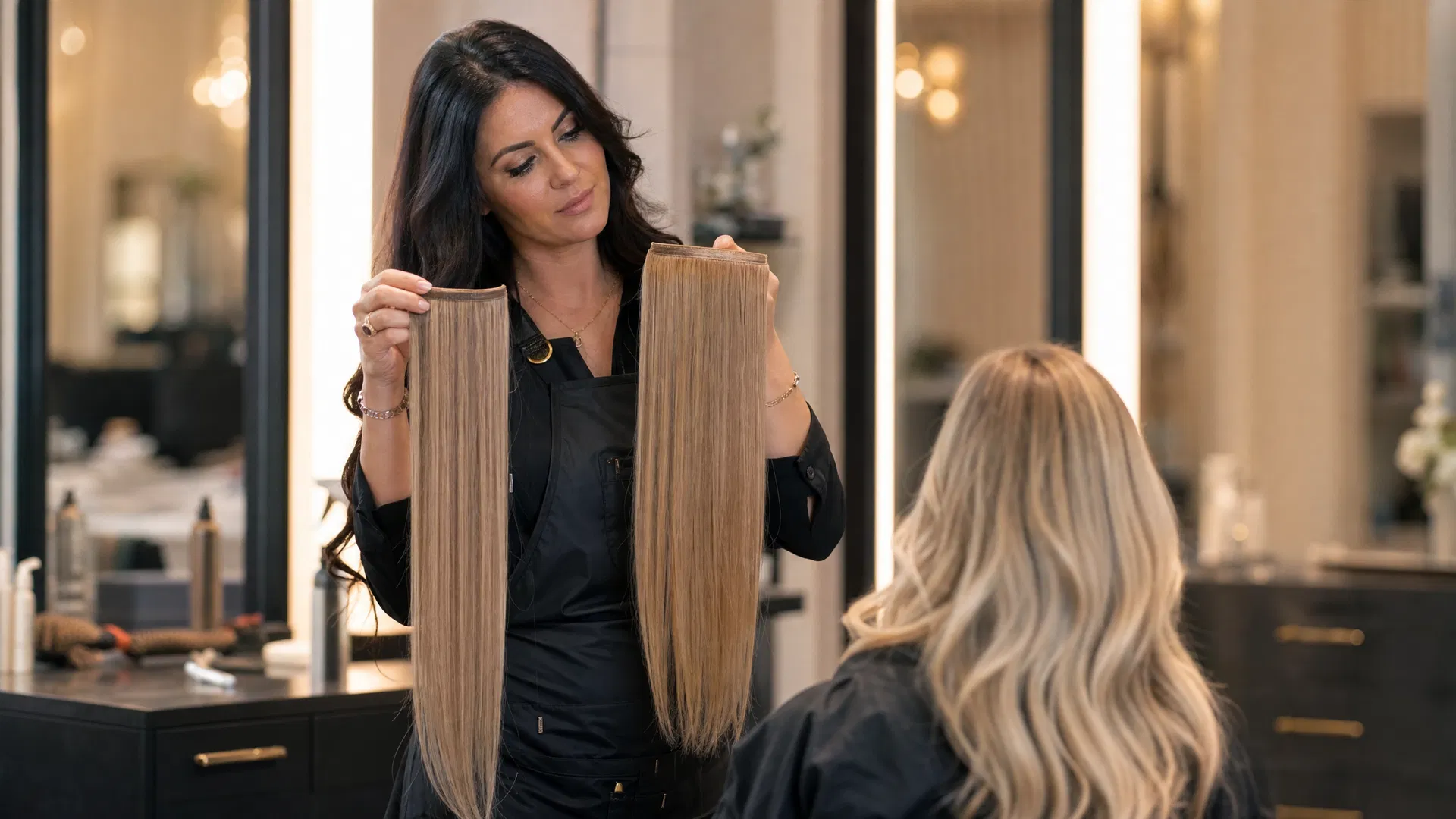
A flat weft — often searched by stylists as a Genius Weft-style weft — is usually chosen for low-bulk, customizable row-based installs. A hand-tied weft is usually chosen for lightweight movement and softness. The right choice depends on the client’s density, lifestyle, maintenance habits, and the stylist’s trained method.
That is the short answer.
But behind the chair, this decision is not just about which weft is thinner or more popular. It is about choosing the product that supports the client’s hair, scalp comfort, styling habits, and long-term maintenance.
Both flat wefts and hand-tied wefts can create beautiful results. Both can be wrong for the wrong client. A strong stylist does not ask, “Which weft is better?” She asks, “Which weft is better for this client?”
The Main Difference Between Flat Weft and Hand-Tied Weft
The biggest difference is construction.
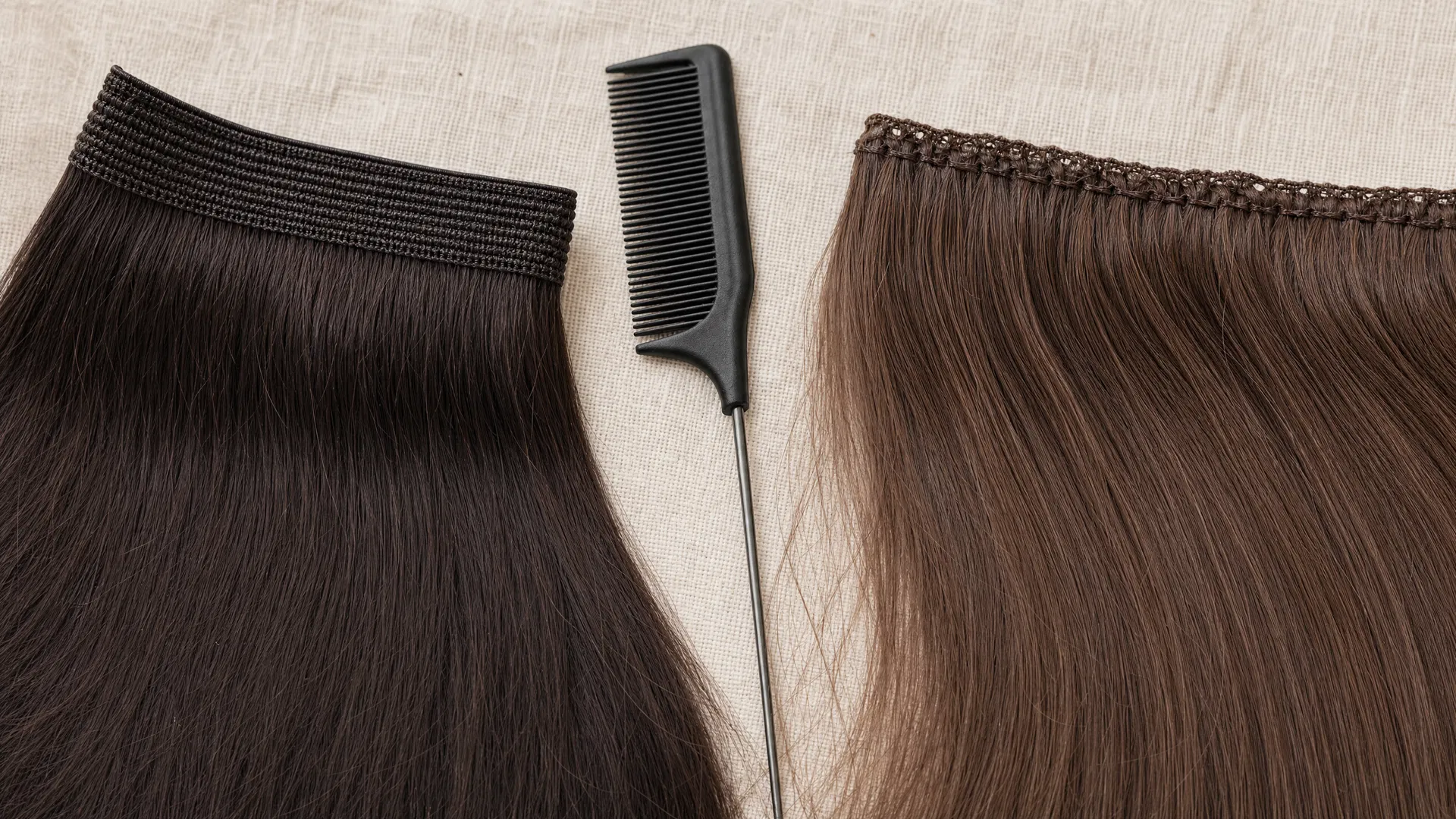
A hand-tied weft is made by tying individual strands of hair onto a thin thread base. This creates a soft, flexible, lightweight weft that moves naturally and can feel very comfortable in the hair.
A flat weft is usually machine-made or machine-finished with a low-profile top seam. Stylists often search for this type of product as Genius Weft because they are looking for a low-bulk, cuttable, customizable weft for row-based installs.
The difference matters because construction affects:
- How the weft sits against the head
- Whether the weft can be cut
- How much customization the stylist has
- How the install feels to the client
- How the weft behaves during maintenance
- Which clients are best suited for each option
Here is the simplest comparison:
| Feature | Flat Weft / Genius Weft-Style Weft | Hand-Tied Weft |
|---|---|---|
| Construction | Machine-made or machine-finished low-profile header | Hand-tied thread base |
| Main strength | Customization and low-bulk row placement | Lightweight softness and movement |
| Cuttability | Designed for customization when handled according to supplier guidelines | Generally not meant to be cut through the weft |
| Best use | Fine to medium density clients needing low-bulk customization | Clients needing soft, lightweight movement |
| Width control | Stronger width customization | Limited width customization |
| Installation style | Bead-row, sew-in, flat-track, hand-tied row-style methods | Bead-row or hand-tied row-style methods |
Neither one wins every time. The client determines the method.
What Is a Flat Weft?
A flat weft is a professional hair extension weft designed with a low-profile top seam so the row can sit closer to the head than a traditional bulky machine weft.
Many stylists search for Genius Weft when they are looking for this type of weft: thin, low-bulk, customizable, and suitable for professional row-based installs.
Flat wefts are often chosen when the stylist wants:
- Lower bulk at the track
- Width customization
- A discreet row
- A weft that can work across different head shapes
- A cleaner option than traditional bulky machine wefts
- A professional weft for fine or medium-density clients with enough anchor hair
The key advantage is control.
A flat weft gives the stylist more flexibility to customize the row, especially when working with different head shapes, section sizes, density patterns, and client preferences.
That is why flat wefts are so useful in professional extension work. They are not just about thinness. They are about control.
What Is a Hand-Tied Weft?
A hand-tied weft is made by manually tying hair onto a fine thread base. The result is a soft, flexible, lightweight weft that can move naturally with the client’s hair.
Hand-tied wefts became popular because they can feel delicate, soft, and comfortable when installed properly on the right client.
Stylists often like hand-tied wefts for:
- Soft movement
- Lightweight feel
- Fine hair clients
- Natural blending
- Flexible row placement
- Clients who want less structure in the row
But the major limitation is customization.
Most hand-tied wefts are not designed to be cut through the weft itself. Cutting through the weft can cause unraveling or shedding depending on the construction and how the weft is handled.
That means the stylist has less freedom to customize width compared with a flat weft or Genius Weft-style product.
Cuttability: Why This Is the Big Difference
For many stylists, the biggest reason to choose a flat weft over a hand-tied weft is cuttability.
A flat weft or Genius Weft-style weft is usually selected because it can be customized to fit the row more precisely, as long as it is cut and installed according to the supplier’s professional guidelines.
That matters because every client’s head shape is different.
A stylist may need to adjust the width of the weft for:
- Smaller heads
- Narrow nape sections
- Custom row placement
- Fine hair density
- Face-framing areas
- Uneven density
- More precise blending
With hand-tied wefts, width customization is more limited. Stylists typically need to fold, stack, or plan placement around the fixed weft size rather than cutting freely through the weft.
That does not make hand-tied bad. It just means the stylist has to plan differently.
| Question | Better Fit |
|---|---|
| Do I need maximum width customization? | Flat weft / Genius Weft-style weft |
| Do I need the softest movement possible? | Hand-tied weft |
| Am I working on a head shape that needs custom row sizing? | Flat weft |
| Am I prioritizing soft, lightweight layering? | Hand-tied weft |
| Do I want more control over section width? | Flat weft |
| Is the client a strong candidate for a delicate, non-cuttable weft? | Hand-tied weft |
The point is simple: flat wefts give more cutting flexibility; hand-tied wefts require more placement planning.
Bulk and Comfort: Which One Feels Better?
This is where stylists need to be careful.
Many people assume hand-tied wefts are always lighter and flat wefts are always better. That is too simplistic.
A hand-tied weft can feel very lightweight and soft. A flat weft can sit very discreetly and give the stylist more customization. Both can feel comfortable when installed on the right client by a trained professional.
Comfort depends on:
- Client density
- Row placement
- Amount of hair installed
- Bead placement
- Tension control
- Scalp sensitivity
- Maintenance habits
- Product construction
- Stylist technique
A flat weft can be a strong choice when the client wants low bulk but the stylist needs more customization. A hand-tied weft can be a strong choice when the client’s hair supports the method and the stylist wants a very soft, lightweight result.
The mistake is assuming one weft solves every comfort issue. It does not.
Client Fit: Who Should Get a Flat Weft?
A flat weft or Genius Weft-style weft may be a better choice for clients who have:
- Fine hair with enough density to support a row
- Medium-density hair where lower bulk is preferred
- A need for width customization
- A smaller head shape or custom row placement
- A history of bulky machine wefts feeling too heavy
- A desire for discreet row-based fullness
- Enough anchor hair to support the install safely
Flat wefts can also be useful for stylists who work with density-sensitive clients, as long as the client still has enough healthy hair to support a row-based method.
That last part matters.
A low-bulk weft is not automatically right for every hair loss client. If the client has advanced crown thinning, major scalp visibility, or not enough anchor hair, a hair topper, beaded topper method, meshless integration, mesh integration, or wig may be the better solution.
Client Fit: Who Should Get a Hand-Tied Weft?
A hand-tied weft may be a better choice for clients who have:
- Fine hair with enough density to support the row
- A need for soft movement
- A preference for lightweight layering
- A stylist who is trained and confident in hand-tied row-style installation
- A maintenance routine that supports the method
- A head shape that works well with the fixed weft width
Hand-tied wefts can create beautiful, natural results. But the client has to be a good fit, and the stylist has to understand the product’s limitations.
The biggest issue is not whether hand-tied wefts are good. They are. The issue is whether they are the best option for the specific client in the chair.
Flat Weft vs. Hand-Tied Weft for Fine Hair
For fine hair, the answer depends on density and coverage needs.
A client can have fine hair texture but still have enough density to support a row-based install. That client may do well with either a flat weft or a hand-tied weft, depending on the stylist’s goals.
A flat weft may be better when:
- The stylist needs to customize the row width
- The client wants low bulk but more structure
- The install requires precise placement
- The client has enough density but cannot hide a bulky machine weft
A hand-tied weft may be better when:
- Soft movement is the top priority
- The client’s density can support the row
- The stylist does not need to cut through the weft
- The client wants an ultra-light feel
But if the client has visible scalp exposure at the crown or part line, neither weft may be the best first recommendation. That client may need a topper or integration method instead.
A smart stylist does not force wefts onto a client who actually needs coverage.
Flat Weft vs. Hand-Tied Weft for Hair Loss Clients
This is where the consultation has to be honest.
Some hair loss clients can wear wefts. Some should not.
A low-bulk flat weft may be useful when the client has enough healthy anchor hair to support the installation and wants fullness or length through the lower or mid sections.
A hand-tied weft may also work for some clients with fine hair when the density and scalp condition support the method.
But for more advanced thinning, especially around the top, crown, or part line, a weft may not solve the problem. In those cases, the better option may be:
- Hair topper
- Beaded topper method
- Meshless integration
- Mesh integration
- Wig, depending on coverage needs
This is why Zora’s hair enhancement approach includes more than one product.
Some clients need Zora Wisp Weft. Some need keratin bonds. Some need toppers. Some need integration. Some eventually need wigs.
The method should follow the client’s hair, not the stylist’s favorite product.
Where Zora Wisp Weft Fits
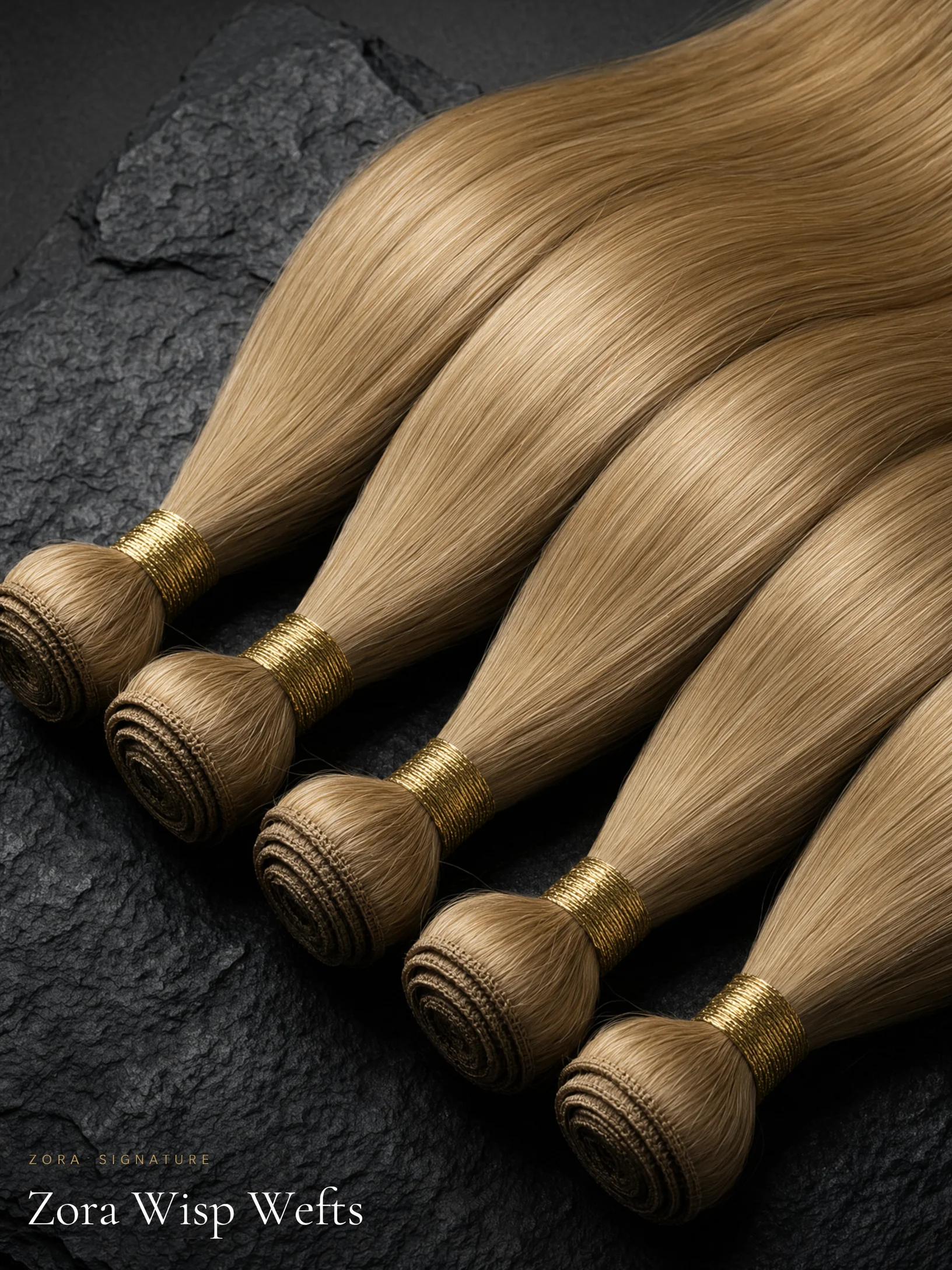
Zora Wisp Weft is Zora Hair’s flat weft for licensed cosmetologists.
It is designed for stylists who want a professional low-bulk weft option for seamless row-based installs. For stylists comparing flat weft vs. hand-tied weft, Wisp Weft belongs in the low-bulk, customizable weft category.
| Feature | Zora Wisp Weft |
|---|---|
| Product type | Professional low-bulk weft |
| Designed for | Licensed cosmetologists |
| Best use | Row-based installs where low bulk and customization matter |
| Installation methods | Bead-row, sew-in, flat-track, and hand-tied row-style methods |
| Client fit | Fine hair, medium density, and density-sensitive clients with enough anchor hair |
| Professional access | License verification required |
Wisp Weft is not about replacing every hand-tied weft. That is not the point.
The point is giving stylists another professional option when the client needs low bulk, customization, and a more discreet row than a traditional machine weft.
Decision Guide: Flat Weft or Hand-Tied Weft?
Use this as a practical decision guide behind the chair.
| Client / Install Need | Better Starting Point |
|---|---|
| Needs the softest possible movement | Hand-tied weft |
| Needs width customization | Flat weft / Genius Weft-style weft |
| Fine hair with enough anchor hair | Depends on density and desired result |
| Medium density and low-bulk row desired | Flat weft |
| Wants very soft layering | Hand-tied weft |
| Smaller head shape or custom row sizing | Flat weft |
| Crown or part-line thinning | Hair topper or integration may be better |
| Advanced hair loss | Meshless integration, mesh integration, or wig may be better |
| Stylist wants more control over row width | Flat weft |
| Client cannot hide bulk from a machine weft | Flat weft may be a better option |
This is the simplest way to think about it:
Choose the weft based on the client’s hair and the result you need — not based on what is trending.
Expert Note from Krista
“Flat wefts and hand-tied wefts can both be beautiful, but they solve different problems. If I need more customization and lower bulk through the row, I look at a flat weft. If I want the softest movement and I do not need to cut through the weft, hand-tied can be a great choice. The mistake is treating one method like it works for every client.”
— Krista Abad, Zora Hair Ambassador and 25-year hair extension and hair loss integration specialist
Common Questions About Flat Weft vs. Hand-Tied Weft
Many stylists search for Genius Weft when they are looking for a low-bulk, cuttable flat weft. Construction varies by supplier, so stylists should evaluate the product’s header profile, customization, hair quality, color consistency, and support before choosing a weft.
No. Zora Wisp Weft is Zora Hair’s flat weft for licensed cosmetologists. It is designed for stylists looking for a low-bulk, customizable weft option for professional row-based installs.
Neither is automatically better. A flat weft may be better when the stylist needs low bulk and width customization. A hand-tied weft may be better when the client is a good candidate and soft, lightweight movement is the priority.
Hand-tied wefts are generally not meant to be cut through the weft itself because cutting can cause shedding or unraveling. Stylists should always follow the supplier’s product guidelines.
Many flat wefts and Genius Weft-style products are designed for customization, but construction varies by supplier. Stylists should follow the supplier’s cutting and installation guidelines to reduce the risk of unraveling, shedding, or product damage.
It depends on the client’s density, scalp visibility, and desired result. Some fine-hair clients may do well with a flat weft. Others may do better with hand-tied wefts, keratin bonds, toppers, or integration methods.
For mild density concerns with enough anchor hair, a low-bulk weft may work. For crown thinning, part-line thinning, or more advanced hair loss, a hair topper, meshless integration, mesh integration, or wig may be more appropriate.
Summary
The flat weft vs. hand-tied weft decision comes down to construction, customization, comfort, and client fit.
A flat weft — often searched as a Genius Weft-style weft — is usually the better choice when the stylist needs low bulk, width customization, and row control. A hand-tied weft is often a strong option when the stylist wants soft movement and does not need to cut through the weft.
Zora Wisp Weft is Zora Hair’s flat weft for licensed cosmetologists. It is designed for professional row-based installs where low bulk and customization matter.
The best stylists do not choose a weft because it is trending. They choose the weft that matches the client’s hair, lifestyle, maintenance, and long-term result.
Need a professional low-bulk weft for licensed stylists?
Explore Zora Wisp Weft, Zora Hair’s flat weft for licensed cosmetologists, or apply for access through the Zora Hair professional program.
Keywords
Professional Access
Questions about Zora Hair?
Contact hello@zorahair.com for current product information. Program details and purchasing terms will be announced.
Professional Inquiries